Fascinating Space Facts

Caleb Ryan
| 23-04-2026
 · Science Team
The universe—vast, mysterious, and filled with wonders—has fascinated humanity for centuries.
From the birth of stars to the immense black holes lurking in deep space, the cosmos offers endless opportunities for discovery.
But did you know there are some truly astonishing facts about the universe that even the most avid space enthusiasts might not know? Let's take a journey through space and uncover some of its most intriguing secrets.
1. Space is Completely Silent
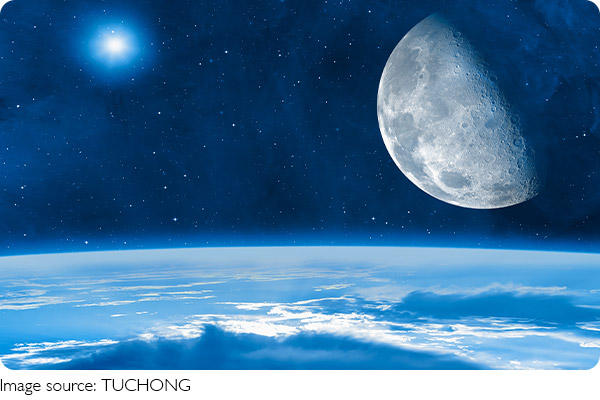
Unlike in the movies, where spaceships zoom through the cosmos accompanied by sound effects, space is completely silent. Sound requires a medium, like air or water, to travel through, but in the vacuum of space, there's no air to carry sound waves. This means that if you were in space, you wouldn't hear anything, not even the roar of a rocket or the hum of equipment. It's one of the most eerie yet fascinating characteristics of the universe!
2. There's More Stars Than Grains of Sand
When you look up at the night sky, you see a handful of stars scattered across the expanse. But in reality, the number of stars in the universe is mind-boggling. In our Milky Way galaxy alone, there are about 100 billion stars. And the universe contains billions of galaxies, each filled with stars. In fact, scientists estimate that there are more stars in the universe than there are grains of sand on all the beaches on Earth! This truly puts into perspective how vast and incomprehensible the cosmos really is.
3. Space is Expanding Faster Than the Speed of Light
One of the most mind-blowing facts about the universe is that it's constantly expanding. And not just at a slow, steady pace—space is expanding faster than the speed of light. This discovery came from observing the redshift of distant galaxies, meaning that as galaxies move away from us, their light is stretched into longer wavelengths. The expansion of space is not just limited to galaxies themselves moving apart; rather, the fabric of space itself is stretching, causing the universe to grow at an accelerating rate.
4. A Day on Venus is Longer Than a Year
The planets in our solar system all have their own unique characteristics, but one of the most peculiar is Venus. A day on Venus—the time it takes for the planet to complete one full rotation—lasts 243 Earth days. But here's the twist: a year on Venus, or the time it takes to orbit the Sun, is only about 225 Earth days. This means that a single day on Venus is longer than an entire year! Venus also rotates in the opposite direction of most planets, making the Sun appear to rise in the west and set in the east.
5. Black Holes Are Incredibly Dense
Black holes are one of the most mysterious and extreme phenomena in the universe. These regions of space have such strong gravitational pulls that nothing, not even light, can escape them. What's even more mind-boggling is how dense they are. The mass of a black hole is concentrated in an incredibly small area, meaning that even a black hole with the mass of our Sun could fit into a space smaller than the size of the Earth! This intense concentration of mass gives black holes their immense gravitational pull.
6. Neutron Stars Are the Densest Objects in the Universe
If you think black holes are the most dense objects in the universe, think again! Neutron stars, which form when massive stars collapse in on themselves after a supernova, are even denser. These stars are so compact that a single teaspoon of neutron star material would weigh about 6 billion tons. Neutron stars are made almost entirely of neutrons and have an intense magnetic field. If you were to stand on the surface of one (which, of course, is impossible), the gravity would be so strong that you'd be crushed almost instantly.
7. Space Is Filled with Invisible Matter
About 85% of the mass of the universe is made up of something scientists can't see or touch, called dark matter. Although we can't observe dark matter directly, we know it exists because of its gravitational effects on visible matter. Without dark matter, galaxies would fly apart, unable to hold together. The exact nature of dark matter remains a mystery, but scientists are continually studying it to unravel its secrets.
8. A “Year” on Jupiter is Much Longer Than Our Own
Jupiter, the largest planet in our solar system, has an orbit that takes it much farther from the Sun than Earth's. This means that a year on Jupiter is much longer than a year on Earth. In fact, it takes Jupiter 12 Earth years to complete one orbit around the Sun. That means if you were born on Jupiter, you'd have to wait a full 12 years just for your first birthday!
9. Space is Full of Giant Galaxies
While our Milky Way galaxy is a massive collection of stars, gas, and dust, it is actually just one of billions of galaxies in the universe. Some galaxies, like the Andromeda galaxy, are even larger than the Milky Way. But the largest galaxy discovered so far is called IC 1101. This supergiant galaxy spans an incredible 6 million light-years across, making it 60 times the size of the Milky Way. Such vast cosmic structures are awe-inspiring and remind us how small we are in the grand scale of the universe.
Conclusion: The Universe is an Infinite Wonder
The universe is truly a place of endless mysteries and mind-boggling facts. From its vastness to the extreme conditions in space, there is always something new to learn and discover. Each new discovery reminds us just how much we have yet to understand about the cosmos, and the adventure of exploring the universe is just beginning. Who knows what other surprising facts lie beyond our reach, waiting to be uncovered? The universe is full of wonder, and the journey of discovery is infinite!