Clay to Ceramic

Caleb Ryan
| 15-05-2026
 · Art Team
There's something genuinely satisfying about ceramic sculpture that no other medium quite replicates.
The material begins responsive and forgiving, yielding to the slightest pressure, then transforms through heat into something permanent and hard.
But the distance between raw clay and finished ceramic involves several distinct stages, each with its own technique and its own risks.
Choosing the Right Clay
The three main types are earthenware, stoneware, and porcelain. Earthenware fires at lower temperatures, has a coarser texture, and is the most forgiving option for beginners — cracks and minor errors are relatively easy to address. Stoneware is denser and more durable, better for larger work or pieces intended for outdoor display. Porcelain, the most refined of the three, produces beautiful surface quality but is unforgiving and difficult to control; it's best approached after building experience with the other two.
Wedging and Building
Before any sculpting begins, the clay must be wedged — pressed and folded repeatedly to eliminate trapped air bubbles. Air pockets expand violently in the kiln and can shatter a piece during firing. Once wedged, the work begins with the largest simplest forms. For complex or tall pieces, a wire armature (aluminum wire is standard) provides structural support. Clay walls should be built at a fairly consistent thickness throughout — inconsistent thickness causes uneven drying and dramatically increases the risk of cracking. Keep work covered with a damp cloth between sessions to prevent premature drying.
Hollowing and Slow Drying
Solid masses of clay cannot survive firing. Any section thicker than about an inch risks trapping moisture that converts to steam in the kiln and fractures the piece from inside. Sculptures built up solid must be hollowed from the bottom or back, leaving walls of roughly half an inch to one inch. Once sculpting is complete, the piece needs to dry slowly — no drafts, no direct sunlight, no heaters nearby. Rotate it periodically to ensure even drying. Large pieces can take days or weeks. Rushing this stage is one of the most common causes of cracks appearing in the kiln.
Bisque Firing
The first firing — called bisque — transforms raw clay into ceramic. The kiln temperature must rise very slowly at first, holding below the boiling point of water long enough for all residual moisture to escape gradually rather than explosively. For most earthenware, the bisque temperature sits around 1,800°F; stoneware and porcelain fire higher. After bisque firing, the piece is porous, fragile, and matte — ceramic in structure but not yet vitrified. It can now receive glaze.
Glazing and the Final Firing
Glazes can be applied by brushing, dipping, or spraying. Thin, even layers are essential — thick application runs and pools in the kiln in ways that are often unpredictable. Allow the glaze to dry completely before the second firing. The glaze firing reaches higher temperatures than the bisque, melting the glaze into a glassy surface and driving the clay body toward its final hardness. Kiln furniture — shelves and props — must be carefully arranged to give each piece room for heat to circulate evenly.
Supporting the Work During Firing
Projecting elements like outstretched arms, thin legs, or large overhangs are vulnerable to sagging under their own weight at high temperatures. Clay supports made from the same clay body as the sculpture — which will shrink at the same rate during firing — can be placed beneath cantilevered sections. A perforated shrink slab placed under the piece's base prevents friction cracking as the clay contracts across the kiln shelf.
Ceramic sculpture asks for patience at every stage — in the building, in the drying, and in the firing. But the material rewards that patience with a surface quality and permanence that is entirely its own.
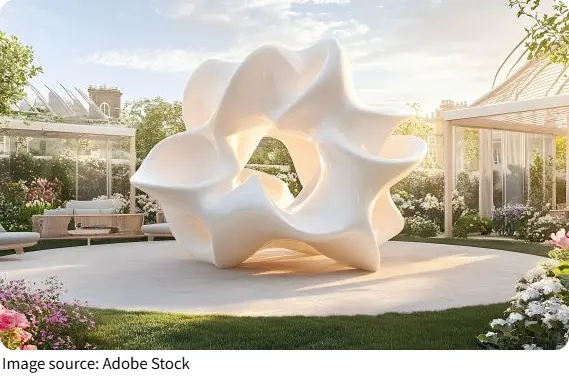
From raw clay to finished ceramic, every stage demands patience, control, and attention to detail. What begins as a soft, responsive material slowly transforms through careful shaping, drying, and firing into something permanent and enduring. The process is not just about creating form, but about respecting timing and technique. In the end, ceramic sculpture stands as a result of both craftsmanship and patience — where every decision made along the way is permanently reflected in the final piece.